ketsku kirjoitti:
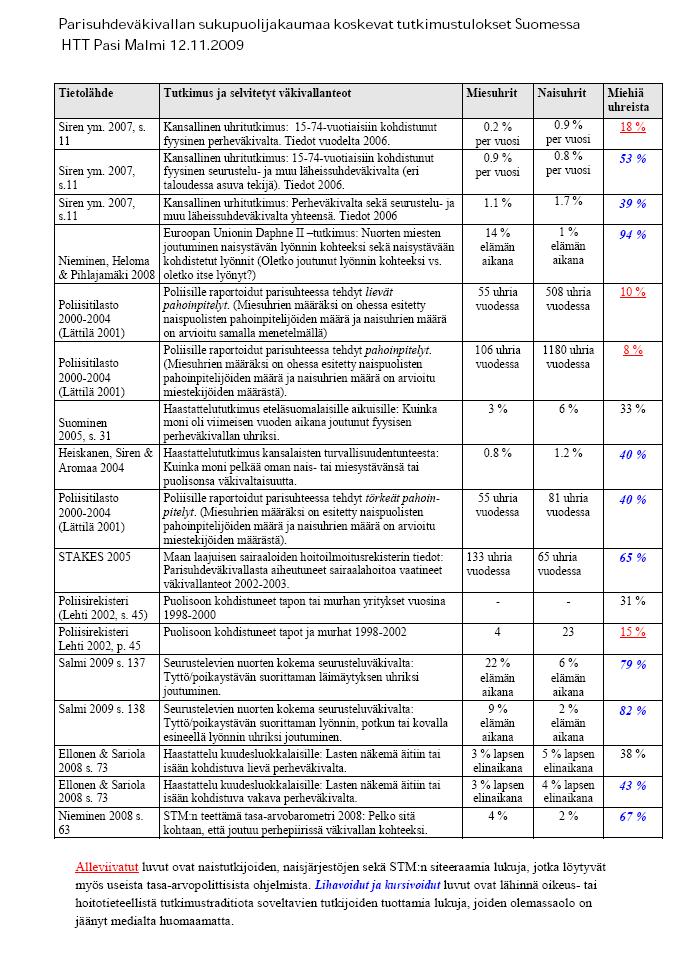
Tapoista suurin osa naisten tekemiä? Ettäkö naiset tappaa parisuhteissa enemmän miehiä kun miehet naisia? Höpö höpö. Ja väkivallaan suhteet menevät aikalailla 85-15 jotta tiedoksesi saatettakoon. Ja tuo 85 on miesten tekosia. Ja seksuaaliväkivallassa prosentit on vielä aika paljon huonommat miehillä. Vaikka sä kuinka sitä toivotkin niin miehet on huomattavasti väkivaltaisempia niin toisiaan kuin naisiakin kohtaan.
Hm, meneeköhän se aina ihan noin kauniisti, ja onkohan nuo lukemat ihan ajan tasalla...??

Tässä ainakin on hiukan erilaisia painotuksia (lähde:
http://en.wikipedia.org/wiki/Domestic_violence):
Sex of assailant
In the most serious cases of violence men dominate. Women are much more likely to be murdered by an intimate partner, regardless of who started the fight. Among the persons killed by an intimate partner, about three quarters are female, and about a quarter are male: in 1999, in the US, 1,218 women and 424 men were killed by an intimate partner, regardless of which partner started the violence and of the gender of the partner. In the US, in 2005, 1181 females and 329 males were killed by their intimate partners.
Dr. Martin Fiebert, from the Department of Psychology of California State University, has compiled an annotated bibliograhy of research relating to spousal abuse by women on men. This bibliography examines 155 scholarly investigations: 126 empirical studies and 29 reviews and/or analyses, which demonstrate that women are as physically aggressive, or more aggressive, than men in their relationships with their spouses or male partners. The aggregate sample size in the reviewed studies exceeds 116,000. Very few studies have shown men to aggress more frequently than women.
However, until recently the bulk of domestic violence research did not even ask about woman-on-man violence. It has also been found that many kinds of behavior, such as pushing and slapping, are experienced by both genders, but are mainly called "violence" by female victims. Early studies that merely asked "have you been a victim of domestic violence" did find far lower levels of male victims; but when they asked about specific behaviors ("have you been slapped, punched,...), the numbers evened out. Justice Department studies show that men are 32 percent less likely than women to report any form of violent victimization.
Luulen, että yksi syy siihen, miksi perinteisesti kyselytutkimukset ovat tuottaneet hyvinkin suuria sukupuolieroja tässä suhteessa on juuri tuo yllä mainittu eli se, että sosiaalisesti ja kulttuurisesti naisten on ollut olennaisesti helpompaa omaksua ja myöntää uhrin asema kuin miesten.
Straus and Gelles found in couples reporting spousal violence, 27 percent of the time the man struck the first blow; the woman in 24 percent. The rest of the time, the violence was mutual, with both partners brawling. The results were the same even when the most severe episodes of violence were analyzed. In order to counteract claims that the reporting data was skewed, female-only surveys were conducted, asking females to self-report, and the data was the same.
The simple tally of violent acts is typically found to be similar in those studies that examine both directions, but some studies show that men's violence may be more serious. Men's violence may do more damage than women's; women are much more likely to be injured and/or hospitalized, wives are much more likely to be killed by their husbands than the reverse (59%-41% Dept of Justice study), and women in general are more likely to be killed by their spouse than by all other types of assailants combined.
Tämä tietysti selittyy keskimääräisellä erolla ruumiinvoimissa, ja on tietysti syytä ottaa huomioon, vaikkei se tietysti väkivaltaa sinänsä oikeuta, tekipä sitä kumpi osapuoli tahansa.
Coramae Richey Mann, a researcher at the Department of Criminal Justice, Indiana University/Bloomington, found that only 59 percent of women jailed for spousal murder claimed self-defense and that 30 percent had previously been arrested for violent crimes.
Women charged with killing their husbands were acquitted in 12.9 percent of the cases, while husbands charged with killing their wives were acquitted only 1.4 percent of the time. In addition, women convicted of killing their husbands receive an average sentence of only six years, while male spousal killers got 17 years, according to an LA Times article citing Department of Justice data.
Eli tasa-arvossa on tosiaan aika lailla ongelmaa myös tässä suhteessa...
These findings, however, may have other problems. Women are far more likely to use weapons in their domestic violence, whether throwing a plate or firing a gun. Women are also much more likely than men to enlist help if they wish to kill their spouse; but such multiple-offender homicides are not counted toward domestic-violence statistics. In addition Farrell points out that there are several "female-only" defenses to murder charges, such as the posthumous allegation of abuse; in short, our data on rates of domestic homicide are incomplete. Furthermore, women are more likely to inflict mental abuse on men more and usually resort to physical abuse first. In such a case the men has no option to defend himself to protect himself when physical abuse occurs. As a result many men are unfairly labeled as abusers when actually the woman is the abuser. This brings the debate on what is an allowable amount of physical defense when trying to avoid the abuser.
Tähän voisi tietysti todeta, että ylipäätään ei pitäisi provosoitua, mutta mikä sitten on suotavaksi katsottava määrä väkivaltaa itsepuolustusta varten, onkin usein käytännössä kinkkisempi juttu, varsinkin jos kyseessä on vain sana vastaan sana ilman ulkopuolisia todistajia kuten lähisuhdeväkivallassa varsin usein on.
In their study of severely violent couples, Neil Jacobson and John Gottman conclude that the frequency of violent acts is not as crucial as the impact of the violence and its function, when trying to understand spousal abuse; specifically, they state that the purpose of battering of whatever direction is to control and intimidate, rather than just to injure.
Tuo varmasti pitää myös paikkansa, ja sitähän monet feministitkin ovat ihan aiheellisesti korostaneet, tosin yleensä unohtaen tai haluten unohtaa sen, että se pätee molempiin sukupuoliin.
There is a whole source of new evidence to suggest that some of the research into family abuse has been politicized. Sam and Bunny Sewell, Family Resources & Research state "that However, misleading statistics are a deliberate fund raising tactic for women's shelters. The shelter movement almost never mentions scientific studies.
Niin, tuo on tietysti yleinen ja huolestuttava ilmiö monella muullakin poliittisesti sensitiivisellä ja usein jo voimakkaasti politisoituneella aihealueella (esim. monet etniset ja sukupuolikysymykset, osin viimeaikoina jopa ilmastokysymykset), joissa alkaa selvästi olla sitä ilmiötä, että etukäteen päätetään miten asioiden pitää olla, ja jos tutkimus ja tosiasiat eivät tätä vahvista, niin sen huonompi sitten niille. Humen giljotiini on näissä keskusteluissa usein päässyt ruostumaan huolestuttavan pahasti...